
Updated on
Synergies are one of the goals of mergers and acquisitions. In order to achieve this and get the most out of your M&A transactions, it is essential to understand the types of synergies that arise and to analyze them in order to maximize them once the transaction is completed.
It is equally important to understand the meaning of synergy in order to develop solid ideas and strategies to capture it.
What is synergy in M&A transactions?
In the context of mergers and acquisitions, synergy is the idea that the combined value and performance of two independent businesses will be greater than the sum of the separate individual parts.
From the outset of a transaction, the objective and significance of mergers and acquisitions is to create long-term synergies by increasing market share, broadening the customer base and enhancing the financial strength of the companies. Indeed, synergy is the potential financial benefit gained when two companies merge.
It is essential to identify the synergies to be gained from a merger or acquisition operation before it takes place in order to make it a success. Moreover, there are many examples of mergers and acquisitions of companies that show this.
Synergy is defined as the interaction or cooperation of two or more organizations to produce a combined effect greater than the sum of their separate efforts. Moreover, synergies are extremely important for both parties involved. They are the driving force behind most mergers and acquisitions.
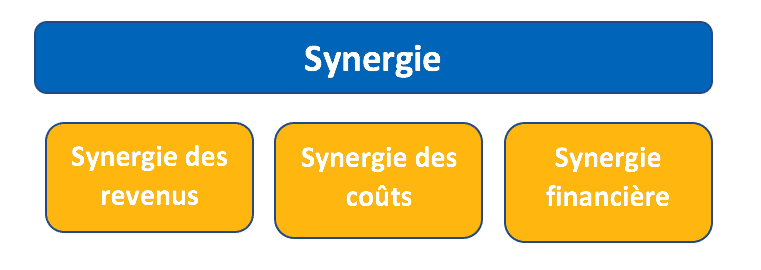
As illustrated in the diagram above, the sources of synergies in mergers and acquisitions are as follows:
- Revenue synergy
- Cost synergies
- Financial synergies
Examples of M&A synergies include
- Revenue synergies
Revenue synergy is based on the principle that the two companies combined can generate more sales than the sum of their individual sales.
However, it should be noted that studies have shown that successful revenue synergies take, on average, a few years longer than cost synergies.
Specifically, McKinsey & Company notes that challenges, such as developing appropriate goals and executing new flow strategies, make revenue synergies more difficult to capture.
Traditionally revenue synergies result from:
- Cross-selling
- Reduction of competition
- Access to new markets
- Mutualization of sales between networks
- Cost synergies
Merging two companies can create savings through :
- Rationalization of marketing channels
Increasing marketing channels and resources can lead to cost reductions.
- Sharing information and resources
Similarly, the partner benefits from access to research and development, which can create production efficiencies that translate into cost savings.
- Lower wages
Although layoffs are not always part of mergers and acquisitions, they are associated with the merger of two companies because the companies do not need two of each and some staff positions. Indeed, the elimination of certain salaries, which are often very high, can result in savings.
- Streamlining processes
Streamlining processes can save time and money because it can make the new company more efficient. In addition, supply chains can become more efficient and the new, larger company can generally negotiate better prices with its suppliers.
With respect to the calculation of cost synergies in mergers and acquisitions, it is important to note that this is a considered estimate rather than an exact calculation. Indeed, identifying overlapping personnel and compensation costs saved, including estimating the impact of sharing supplies and even office space, and predicting the role that efficiency will play when the two companies merge are parameters, among others, to be considered when calculating cost synergies.
- Financial synergies
While these synergies may be perceived as somewhat misleading, there can be tax and loan benefits associated with the combination of two businesses. Indeed, financial synergies are often the most valued. This type of synergy includes improved financial metrics such as revenue, debt capacity, cost of capital, profitability, etc.
Revenue, cost and financial are the three most common examples of acquisition synergies. The goal of any company is to increase synergies and hope that they will reach their full potential after closing.
How to create synergy in mergers and acquisitions?
It is true that no one wants an agreement that is only good on paper, which is why achieving synergy is essential.
Therefore, while agreements can fail for a variety of reasons, one of them is the inability to realize the intended synergies. With that in mind, here’s how to maximize your deal’s synergy realization:
- Don’t lose sight of your goal and your main objective
To achieve synergy, make sure all stakeholders and team members stay focused on the predetermined goal throughout the M&A process. Adopting a more agile M&A practice can help you because with this method, you focus on the main objective and not on a long list of tasks that may or may not be necessary.
- Focus on fast value creators
Since the first year of integration is critical to capturing synergies, it is wise to focus on “easy” synergies at the outset that will yield the greatest return later on. While making it clear that these “easy” value drivers must be consistent with your overall goal. This will help you be trackable while maximizing your chances of success.
- Plan the integration properly
Poor integration practices and not properly planning the integration when the audit begins often result in lost synergies.
- Retain key employees from acquired companies, but don’t neglect the importance of culture
Employees are what make companies successful and when a merger or acquisition takes place, key employees are often a source of performance. In order to retain key personnel and create a comfortable environment, management must focus on culture and change management.
- Follow the synergy process
When executives are trying to capture different types of synergies, they need a way to track the progress of the different synergies involved in their deal. In fact, a centralized location for this tracking, such as an M&A project management platform, is recommended. In addition, M&A synergy benchmarks should be created and reviewed for the transaction.
- To take advantage of revenue synergies, analyze your customer base
In order to capture revenue synergies, it is essential to conduct a thorough analysis of each customer relationship. In fact, the sales team must be involved in this customer study as they will need to understand the strategy as well as the objectives of the synergy.
How to create a synergy model for mergers and acquisitions?
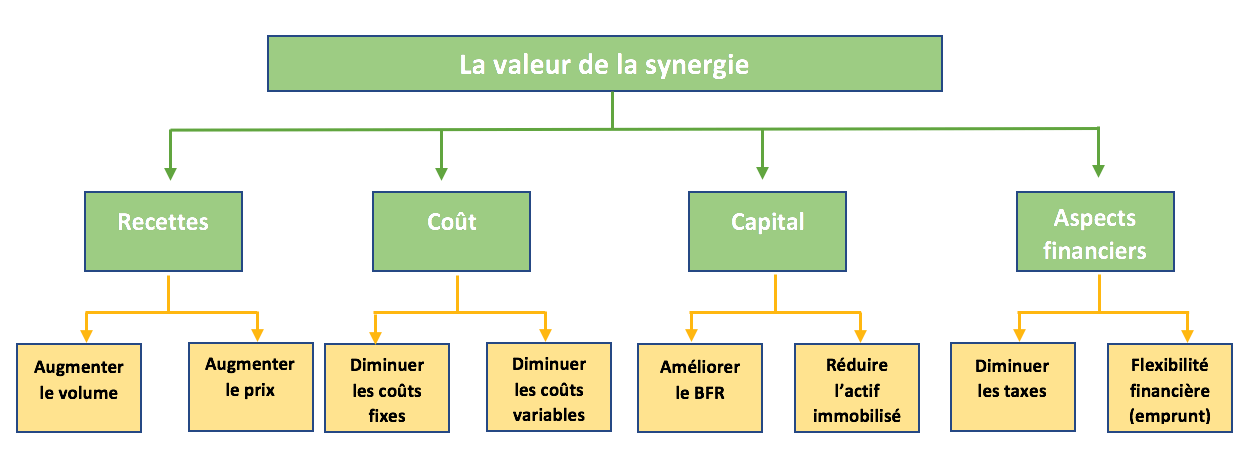
Synergies are often calculated by adding to the arithmetic incremental value, the financial translation of the synergy(ies) in terms of value creation or savings (lower expenses). In addition, when developing a M&A synergy model, consider the following parameters: How to sell, what to sell and where to sell.
It is important to examine where the opportunities lie to capture synergies and create value in these three categories.
Here again, an expert in mergers and acquisitions will certainly be able to accompany you and guide you towards the best way to proceed.
In summary
Whatever M&A synergies are present in a given transaction, they must be considered at every stage of the transaction. Synergies can often be easy to identify but difficult to achieve. That’s why it’s critical to understand that at closing, there is still a lot of work to be done to achieve the identified benefits. Post-closing synergy work must be planned early and continue for months, sometimes even years, after closing.
Furthermore, if executives prefer to be ambitious in identifying and defining the synergies expected from the agreement, it is essential that they be realistic and not overestimate the potential synergies.
Discuss your next step confidentially
Clarify objectives, timing and options with a senior M&A adviser.
Book a confidential meeting
